Visualizzazione post con etichetta travel to italy. Mostra tutti i post

mercoledì 25 giugno 2014

Turin: the Park of La Mandria, residence for hunting and love

Welcome in My Own Italy, to discover Italy with my Personal Touch!
Today our travel is to Turin, and we'll  have a pleasant walk in the Park of La Mandria.
I'm sure that Piedmont will be able to surprise you with the elegance of the ancient royal aristocracy!

The Castle, situated in the Park of La mandria, was built during the creation of the Venaria Reale  for breeding thoroughbred horses.
  It was subsequently converted by king Vittorio Emanuele II for habitation, soon becoming his favourite place of residence.
 

Strongly connected to the various hunting activities of the sovereign, this estate was where the king could escape the rigours of court duties and pursue his multiple hobbies and express his great love towards his wife Rosa Vercellana, to whom the castle was destined.


The Royal Apartments, perfectly furnished and preserved, consist of 18 rooms with a cosy and family-like nature, which revealed the choices and tastes of the client.


To this historical building is now added the importance and value of the wildlife heritage of the park, that is the largest one in Italy surrounded by walls (the second in Europe) with hiking trails among ancient trees and delightful small architectural gems.


Since 1997 the Castle of Mandria, along with all the other residences of Savoy in Piedmont, a World Heritage Site (UNESCO). Park of La Mandria is a must-see destination in your holiday to visit the cities of art in Italy.


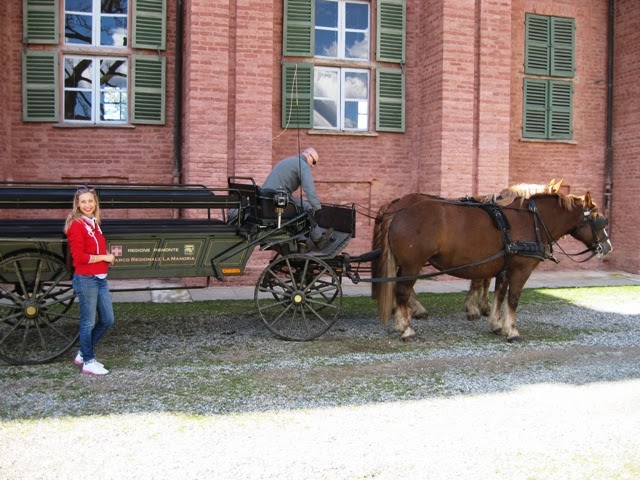
I personally wanted to take a ride in the carriage .... a truly unique experience!
 
Leisure with me, this is my tourism!

martedì 10 giugno 2014

Rimini: the imposing fortress of St. Leo and Valmarecchia

Hello, my friends! Welcome in My Own Italy to discover Italy with my personal touch!

Today our travel is to Emilia Romagna in province of Rimini: I'll let you to discover the impregnable fortress of San Leo, also linked to the legend of the famous and discussed alchemist Count Alessandro Cagliostro, who was kept prisoner here!


The Fortress of San Leo is situated on top of the rocky spire that overlooks the city and dominates the Valmarecchia.


The Fortress is the symbol of this ancient town and medieval village.


 This impregnable Fortress was considered of great importance since the Middle Ages because of its formidable strategic position: in fact, it stands on the highest point of the rock overlooking the Valmarecchia, surrounded by a series of steep vertical walls impassable by any side.


The Fortress is impressive and beautiful: you can breathe a magical and mysterious atmosphere, issued by the legend of the dark character of the Count Cagliostro, cunning and devious alchemist, who ended his day in its cells in 1795 after long years of imprisonment.


For this characteristic and also for the attractive location on the border of Monte Feltro, this Fortress was the subject of clashes and bloody fights between tribes and of the most important families in the history of Italy.


Even after the unification of Italy, the Fortress continued to fulfill its function as a prison until 1906.

From the square of the Fortress, as well as from the Towers, you can enjoy a unique landscape which offers, once again, a wonderful view of the hills of Emilia Romagna: this village is a must-see destination in your holiday in Italy.


Leisure me, this is my tourism!


giovedì 3 aprile 2014

Emilia, along the River Panaro: the Vignola Fortress

Hello, my friends! Welcome in My Own Italy to discover Italy with my personal touch!

Today our travel is to Emilia Romagna and we're going to walk along the valley of the River Panaro, in the province of Modena: I suggest you to visit to the Vignola Fortress.


The Vignola Fortress is a military fortress that dominates the valley of the River Panaro.


The imposing structure of the Fortress is visible in the distance. It looks like a mighty quadrangle, the final product of many phases of construction, which have transformed it from Roccaforte to imposing noble mansion. 


  The name "Vignola" comes from the Latin "vineola", which means "little vine" and today the the grapevine appears in the banner of the city. Until the early years of the fifteenth century the building was used for military functions; in 1401 the noble of Ferrara Uguccione Contrari received the feud Vignola as a gift from the lord of Ferrara Nicolò III d'Este. 


During the two following decades the Fortress profoundly changed its function, becoming the sumptuous home richly frescoed of the Family Contrari, accustomed to the comforts and magnificence of the court of Ferrara. 


This dynasty died out in 1577, the Fortress passed to the Boncompagni, who entrusted the administration of the fief to a governor, visiting Vignola sporadically. The Fortress, built of limestone, commonly called "tuff" overlooking the river, is today on five floors, from the basement, where there are the rooms of Grassoni and Contrari, to the walkways.
Regarding the halls and their function, the ground floor is open to the those engaged public events and official moments of the court life: banquets, parties, music, theater, administration of justice.


The first floor was dedicated to the private apartments of the ladies and lords and to their guests. At the top level there are the rooms probably used as the servants' quarters and  troops stationed at the fortress, but also there were the service areas, so essential in a building of this size. 


During the nineteenth century the political and social institutions in Vignola have found their headquarters inside the building: The Town Hall, the Library, and the Cassa di Risparmio di Vignola, which acquired the property in 1965.


In the end, Vignola is a must-see destination for your holiday in Italy to discover the italian villages.


Leisure with me, this is my tourism! 

mercoledì 26 marzo 2014

Turin: the aristocratic elegance of the Villa della Regina


Hello my friends, welcome to My Own Italy to Discover Italy with my personal touch!
Today we are in Turin, to travel to Piedmont  Region, and my suggestion is to visit the Villa della Regina, recently opened after a long period of restoration.


 The Villa della Regina  is a villa of the sixteenth century situated on the hill of Turin, is part of the Savoy  Residences in Piedmont.


The Villa gets the name of "Villa of the Queen" because it was the favorite residence of two spouses of The King of Sardinia, Anna Maria of Orléans and Maria Antonia Ferdinanda of Spain.

 The ducal residence constituted a model for the "vines" and the villas of the aristocracy and the bourgeoisie. The Villa, in the center of Italian gardens, spread to the main floor from the great central hall.
 The structure of Villa della Regina is typically a famous sixteenth-century Italian garden with an amphitheater in the back. When you come to the driveway, you face the front of the square-elliptical terrace. The gardens have fountains and pavilions, the crowning of the garden there is a large forest.

 The enteriors of Villa della Regina are sumptuous, the hall leads to the Royal Apartments richly decorated, in which is placed in an exemplary way the eighteenth century taste for "chinoiserie"!
Abandoned after the exile of Savoy and hit by Allied bombing during World War II, the Villa has experienced as a result of 50 years of total degradation.


Today, after an important restoration, the villa has been reopened to the public.
 The upper floors will house the Regional Centre for Documentation and Cataloguing Cultural Heritage.


The Villa della Regina, in my opinion, is  extraordinary beautiful. 
Certainly a must-see destination in your holiday in Italy to visit the Cities of Art.
 
Leisure me: this is my tourism!


lunedì 17 marzo 2014

Piacenza: Castell'Arquato and the Fortress of Visconti

 Welcome to My Own Italy to discover Italy With My Personal Touch!
Our travel today is to Emilia Romagna Region, between Parma and Piacenza: I'm talking about Castell'Arquato!

After your visit, I'm sure you will taste the famous specialties of Piacenza: I mean "Torta Fritta" and cold cuts in   Trattoria Capoponte: delicious!!


The medieval village of Castell'Arquato is strategically located on the hills of Val D'Arda valley, castled on the hill overlooking the pass.
 
It is assumed to be a military camp (castrum), dating back to the Roman colonization of the area. Then it developed as a small rural town thanks to the favorable position of dominance on the road network.


The historical part is really rich. The Fortress of Visconti, commissioned by the city of Piacenza and erected by Luchino Visconti between 1342 and 1349, is one of the most remarkable military factories in Northern Italy.


You can also admire the Palace of Podestà, built at the end of 300. In the midst of the windows is painted the coat of arms with two rampant lions COMMUNITAS CASTRI ARQUATI and a castle tower. The Palace of Podestà is not usually open to the public, but it is often used for exhibitions.


Castell'Arquato is a rare beauty village of art, steeped in the atmosphere of ancient times: you just have to visit it and discover its mysterious charm: a must-see destination in your holiday to discover the Villages in Italy.


Leisure me: this is my tourism!

mercoledì 12 marzo 2014

Florence: Ponte Vecchio, romance and history

Hello, my friends! Welcome to My Own Italy to discover Italy with my personal touch!
Our travel today is to Tuscany and we're going to visit one of the most famous bridges in the worldPonte Vecchio in Florence.
Ponte Vecchio is a very important symbol both from the historical point of view and from the architectural one.

 Built near a crossing of the Roman era, the Ponte Vecchio was until 1218 the only bridge across the Arno River in Florence until 1218. The bridge, as we see it today, was built in 1345 after a violent flood that destroyed the previous one.

 Initially, these were the shops of butchers and fishmongers but by order of Ferdinand I in 1593, they were replaced by goldsmith shops because the smell was felt constantly and the nobles did not enjoy similar scents.


 Above Ponte Vecchio you can see a beautiful part of the Vasari Corridor. This corridor, built in 1565 by Giorgio Vasari, passes just above the shops of goldsmiths that are currently on the sides of the bridge.


 Commissioned by the Medici, it allowed them to move from the Palazzo Vecchio to Palazzo Pitti without having to go through the streets of Florence in total safety.


On Ponte Vecchio in 1901 a bust of Benvenuto Cellini, a famous glodsmith  of the sixteenth century, was inaugurated on the occasion of the fourth centenary of his birth.


During the Second World War, German troops destroyed all the bridges of Florence, except this one. However they blocked the access to the bridge destroying the two medieval buildings on either side. 


 Visitors who come in Florence can't miss an evening stroll on the Ponte Vecchio. At night, in fact, when the wooden doors of the shops are closedand they look just like coffers, the atmosphere on the bridge becomes even more charming and romantic and it really can't be missed!
 

Leisure with me, this is my tourism!