Hello, my friends! Welcome to My Own Italy to discover Italy with my personal touch!
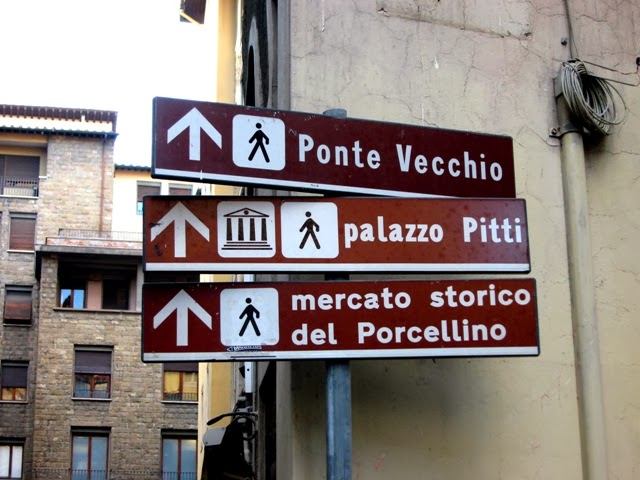
Our travel today is to Tuscany and we're going to visit one of the most famous bridges in the world: Ponte Vecchio in Florence.
Ponte Vecchio is a very important symbol both from the historical point of view and from the architectural one.
Built near a crossing of the Roman era, the Ponte Vecchio was until 1218 the only bridge across the Arno River in Florence until 1218. The bridge, as we see it today, was built in 1345 after a violent flood that destroyed the previous one.
Initially, these were the shops of butchers and fishmongers but by order of Ferdinand I in 1593, they were replaced by goldsmith shops because the smell was felt constantly and the nobles did not enjoy similar scents.
Above Ponte Vecchio you can see a beautiful part of the Vasari Corridor. This corridor, built in 1565 by Giorgio Vasari, passes just above the shops of goldsmiths that are currently on the sides of the bridge.
Commissioned by the Medici, it allowed them to move from the Palazzo Vecchio to Palazzo Pitti without having to go through the streets of Florence in total safety.
On Ponte Vecchio in 1901 a bust of Benvenuto Cellini, a famous glodsmith of the sixteenth century, was inaugurated on the occasion of the fourth centenary of his birth.
During the Second World War, German troops destroyed all the bridges of Florence, except this one. However they blocked the access to the bridge destroying the two medieval buildings on either side.
Visitors who come in Florence can't miss an evening stroll on the Ponte Vecchio. At night, in fact, when the wooden doors of the shops are closedand they look just like coffers, the atmosphere on the bridge becomes even more charming and romantic and it really can't be missed!
Leisure with me, this is my tourism!
Visualizzazione post con etichetta florence. Mostra tutti i post
mercoledì 12 marzo 2014
mercoledì 19 febbraio 2014
Florence and the mysterious Basilica of San Miniato al Monte
Hello, my friends! Welcome to My Own Italy to discover Italy with my personal touch!
Today we continue our travel to Tuscany and I'd like to introduce you to a magic and mysterious place: the Basilica of San Miniato al Monte in Florence.
The Basilica of San Miniato al Monte stands on a hill to the south-east of the center of Florence, near Piazzale Michelangelo, and is considered one of the finest examples of Florentine Romanesque style.
The church is dedicated to Miniato, a Christian of Armenian origin, who was beheaded outside the walls of Florence (in the Porta alla Croce, Piazza Beccaria) for professing his faith.
The legend tells that San Miniato picked up his head and crossed the river Arno and then went up the hill where he was buried and where it is the church dedicated to him.
The Basilica of San Miniato is full of symbolism: the whole structure seems to have been built on the number 5, which is closely related to the golden ratio, through the pentagon and dodecahedron that comes from this. In the symbolism of the numbers, 5 is the number of the sun but also the quintessential symbol of the spiritual and rooted in the human spirit.
Inside the Church you may find symbolic animals, some stylized like the pelican: its place is among the various geometric shapes that make up the sacred space in front of the Presbytery, but in an elevated position almost to the roof. The Pelican lends itself to a double symbolic significance, both as an image of Christ, and as the image of God who sacrifices his son by raising him from the dead
The facade of the church is covered in two-tone green and white marble, in the typical Florentine Romanesque style of the eleventh-thirteenth century. On facade stands out of the thirteenth century mosaic depicting Christ enthroned between the Virgin and San Miniato, while on the top of the front is placed a bronze eagle that represents the guild of merchants of the Art of Wool (Art Calimala) that from the thirteenth century had the patronage of the church.
Outside the Church there is the Bishop's Palace, the former summer residence of the bishops of Florence, who became convent, a hospital and a Jesuit house.
Climb up the stairs of the building and you will be delighted at the sight of one of the world's most famous Italian cities: Florence, here presented in all its beauty!
Leisure with me, this is my tourism!
Today we continue our travel to Tuscany and I'd like to introduce you to a magic and mysterious place: the Basilica of San Miniato al Monte in Florence.
The Basilica of San Miniato al Monte stands on a hill to the south-east of the center of Florence, near Piazzale Michelangelo, and is considered one of the finest examples of Florentine Romanesque style.
The church is dedicated to Miniato, a Christian of Armenian origin, who was beheaded outside the walls of Florence (in the Porta alla Croce, Piazza Beccaria) for professing his faith.
The legend tells that San Miniato picked up his head and crossed the river Arno and then went up the hill where he was buried and where it is the church dedicated to him.
The Basilica of San Miniato is full of symbolism: the whole structure seems to have been built on the number 5, which is closely related to the golden ratio, through the pentagon and dodecahedron that comes from this. In the symbolism of the numbers, 5 is the number of the sun but also the quintessential symbol of the spiritual and rooted in the human spirit.
Inside the Church you may find symbolic animals, some stylized like the pelican: its place is among the various geometric shapes that make up the sacred space in front of the Presbytery, but in an elevated position almost to the roof. The Pelican lends itself to a double symbolic significance, both as an image of Christ, and as the image of God who sacrifices his son by raising him from the dead
The facade of the church is covered in two-tone green and white marble, in the typical Florentine Romanesque style of the eleventh-thirteenth century. On facade stands out of the thirteenth century mosaic depicting Christ enthroned between the Virgin and San Miniato, while on the top of the front is placed a bronze eagle that represents the guild of merchants of the Art of Wool (Art Calimala) that from the thirteenth century had the patronage of the church.
Outside the Church there is the Bishop's Palace, the former summer residence of the bishops of Florence, who became convent, a hospital and a Jesuit house.
Climb up the stairs of the building and you will be delighted at the sight of one of the world's most famous Italian cities: Florence, here presented in all its beauty!
Leisure with me, this is my tourism!
Iscriviti a:
Post (Atom)