Visualizzazione post con etichetta Piedmont. Mostra tutti i post

mercoledì 25 giugno 2014

Turin: the Park of La Mandria, residence for hunting and love

Welcome in My Own Italy, to discover Italy with my Personal Touch!
Today our travel is to Turin, and we'll  have a pleasant walk in the Park of La Mandria.
I'm sure that Piedmont will be able to surprise you with the elegance of the ancient royal aristocracy!

The Castle, situated in the Park of La mandria, was built during the creation of the Venaria Reale  for breeding thoroughbred horses.
  It was subsequently converted by king Vittorio Emanuele II for habitation, soon becoming his favourite place of residence.
 

Strongly connected to the various hunting activities of the sovereign, this estate was where the king could escape the rigours of court duties and pursue his multiple hobbies and express his great love towards his wife Rosa Vercellana, to whom the castle was destined.


The Royal Apartments, perfectly furnished and preserved, consist of 18 rooms with a cosy and family-like nature, which revealed the choices and tastes of the client.


To this historical building is now added the importance and value of the wildlife heritage of the park, that is the largest one in Italy surrounded by walls (the second in Europe) with hiking trails among ancient trees and delightful small architectural gems.


Since 1997 the Castle of Mandria, along with all the other residences of Savoy in Piedmont, a World Heritage Site (UNESCO). Park of La Mandria is a must-see destination in your holiday to visit the cities of art in Italy.


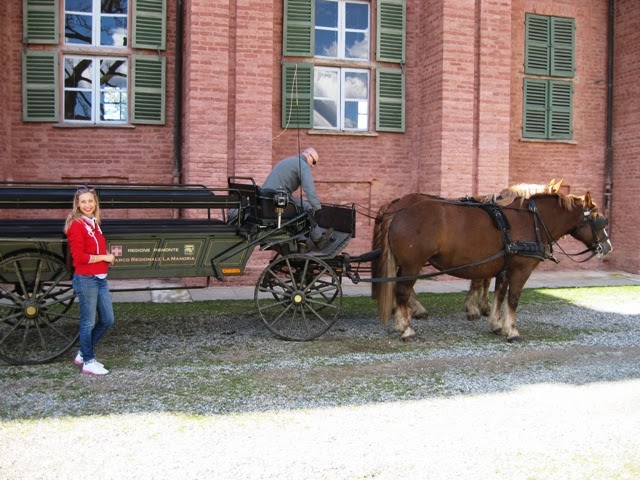
I personally wanted to take a ride in the carriage .... a truly unique experience!
 
Leisure with me, this is my tourism!

mercoledì 28 maggio 2014

Turin: the Park of La Mandria, residence for hunting and love

 Welcome in My Own Italy, to discover Italy with my Personal Touch!
Today our travel is to Turin, and we'll  have a pleasant walk in the Park of La Mandria.
I'm sure that Piedmont will be able to surprise you with the elegance of the ancient royal aristocracy!

 The Castle, situated in the Park of La mandria, was built during the creation of the Venaria Reale for breeding thoroughbred horses.
   
It was subsequently converted by king Vittorio Emanuele II for habitation, soon becoming his favourite place of residence.


Strongly connected to the various hunting activities of the sovereign, this estate was where the king could escape the rigours of court duties and pursue his multiple hobbies and express his great love towards his wife Rosa Vercellana, to whom the castle was destined.


The Royal Apartments, perfectly furnished and preserved, consist of 18 rooms with a cosy and family-like nature, which revealed the choices and tastes of the client.


To this historical building is now added the importance and value of the wildlife heritage of the park, that is the largest one in Italy surrounded by walls (the second in Europe) with hiking trails among ancient trees and delightful small architectural gems.

Since 1997 the Castle of Mandria, along with all the other residences of Savoy in Piedmont, a World Heritage Site (UNESCO). Park of La Mandria is a must-see destination in your holiday to visit the cities of art in Italy
  I personally wanted to take a ride in the carriage .... a truly unique experience!


Leisure with me, this is my tourism!

mercoledì 26 marzo 2014

Turin: the aristocratic elegance of the Villa della Regina


Hello my friends, welcome to My Own Italy to Discover Italy with my personal touch!
Today we are in Turin, to travel to Piedmont  Region, and my suggestion is to visit the Villa della Regina, recently opened after a long period of restoration.


 The Villa della Regina  is a villa of the sixteenth century situated on the hill of Turin, is part of the Savoy  Residences in Piedmont.


The Villa gets the name of "Villa of the Queen" because it was the favorite residence of two spouses of The King of Sardinia, Anna Maria of Orléans and Maria Antonia Ferdinanda of Spain.

 The ducal residence constituted a model for the "vines" and the villas of the aristocracy and the bourgeoisie. The Villa, in the center of Italian gardens, spread to the main floor from the great central hall.
 The structure of Villa della Regina is typically a famous sixteenth-century Italian garden with an amphitheater in the back. When you come to the driveway, you face the front of the square-elliptical terrace. The gardens have fountains and pavilions, the crowning of the garden there is a large forest.

 The enteriors of Villa della Regina are sumptuous, the hall leads to the Royal Apartments richly decorated, in which is placed in an exemplary way the eighteenth century taste for "chinoiserie"!
Abandoned after the exile of Savoy and hit by Allied bombing during World War II, the Villa has experienced as a result of 50 years of total degradation.


Today, after an important restoration, the villa has been reopened to the public.
 The upper floors will house the Regional Centre for Documentation and Cataloguing Cultural Heritage.


The Villa della Regina, in my opinion, is  extraordinary beautiful. 
Certainly a must-see destination in your holiday in Italy to visit the Cities of Art.
 
Leisure me: this is my tourism!


venerdì 14 febbraio 2014

Monastero Bormida, between noble knights and polenta record

 Hello my friends, welcome to My Own Italy to discover Italy with my personal touch!
Our travel today is to Piedmont, in the picturesque village of Monastero Bormida where we expected a fascinating castle and a record delicacy: polenta!


Monastero Bormida, located in the province of Asti, takes its name from to the settlement of a group of Benedictine monks who, around 1050 circa, were called by the Marquis of Monferrato Aleramo from San Benigno Canavese (Abbey Fruttuaria) to plow and sow the lands devastated by the invasions of the Saracens.  


The present castle corresponds exactly to the site of the original monastery, of which there are only a few walls and the bell tower, especially those on the square of the tower.


 Most likely there was a previous monastery founded by the Lombards, as witnessed by the cult of Santa Giulia (whose devotion was widespread in northern Italy by the Lombards) that is still the patron saint of the village and the one to whom is dedicated the eighteenth century parish church, and from some Lombard place-names as Braia, which means the region that is near a river.


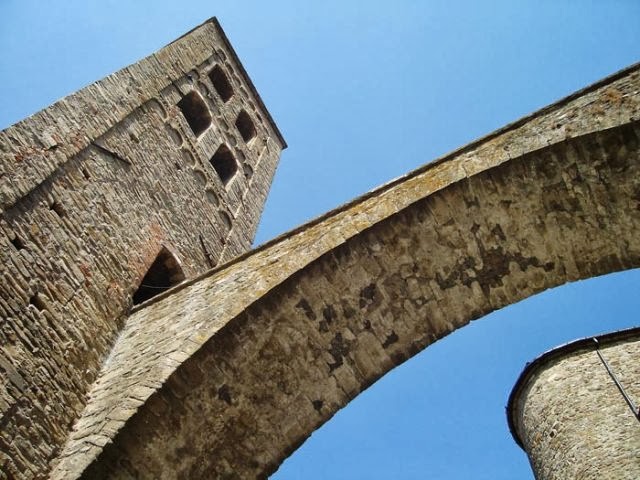
During the fifteenth century the first defensive structure was added by the Marquis del Carretto and subsequent renovations and expansions were followed, such as the medieval arch that connects the castle to the tower. The tower, 27 meters high in the Lombard style, presents friezes, and hanging arches made ​​of bricks and stones.


 Today, the castle has a seventeenth-century facade and maintains the sixteenth century loggia on the back which can also be visited. The family Carretto in the middle of the nineteenth century ceded the property to the Della Rovere family which followed the Polleri family of Genoa who sold it to the municipality, the current owner.


In front of the castle is the characteristic lift bridge, and to get inside, you need to go through the old entrance door in the ancient city wall.
   The tour begins along the outer perimeter of the castle in order to understand the location and history of the structure over the centuries. Then you enters inside in the plans nobles, whose rooms, transformed in the seventeenth century, have mosaic floors and frescoed ceilings sailing and cruising in floral and geometric patterns.


The halls will host the farm museum, opening soon. The visit continues with the walkways on the top and ends in the spacious cellars.
  The medieval Monastero Bormida square, in front of the castle every year, the second Sunday of March, is the theater of Polentone Festival, one of the oldest gastronomic events in the history of Italian cuisine, which takes place from 1573.


 It is from the sixteenth century that this area celebrates at the end of winter, its most traditional product, that is corn flour, which also took the path of organic and integral.
The event was created by ancient propitiatory ceremonies concerning the arrival in the country of magnin which stagnated the pots, and according to a legend it is linked to an act of generosity of the Marquis Del Carretto, who fed with polenta, sausage and onion omelette a group of boilermakers exhausted by hunger, who donated to the land the huge copper pot in which it is still cooked the huge polenta, which is served to the public with the accompaniment of sausage and onion omelette.


On this occasion in the alleys of the old town are recreated with philological care the ancient crafts, performed by the elders of Monastero and the neighboring countries, with vintage gear. It will be possible, in addition to polenta, taste and buy other agricultural produce, wine and dairy hills of Asti.


 The following Monday, classical Polentino of polenta and wild boar.
In short, if you are a gourmand and loved the culinary tradition of our beautiful country, and you are eager for a bit of fun, leisure me: this is my tourism!


martedì 11 dicembre 2012

Piedmont: Lake Orta, The most romantic Lake in Italy


San Giulio Island, Lake Orta (Italy)
Hello my friends, Welcome again in My Own Italy !
Today my personal suggestion is  The Orta Lake, in Piedmont.

Sacro Monte d'Orta
Lake Orta, known as one of the most romantic lakes in Italy, is situated in the Cusio area, which extends from the lower area of the Ossola valley to the western shore of the lower Lake Maggiore area. 

 Once arrived in Orta you can not miss a visit to the Sacro Monte .  
A Chapel of Sacro Monte d'Orta
The sacred place comprises a total of 20 chapels (originally the project envisaged 36) that illustrate the life of Saint Francis of Assisi.

Also the convent of the Capuchins connected to the church, which was still dedicated to Saint Nikolaos in the beginning, but also to Saint Francis whose extraordinary vicissitudes impregnate the itinerary and also its peak.
Chapel XX of St. Francis


The church also has a precious wooden statue depicting the Pietà, which in 1538 was at the centre of a miracle: the wooden Madonna became the subject of worship and perhaps this boosted selecting this place as the location of such an important spiritual project.


Inside the Chapel XX


The Sacro Monte of Orta was mostly built between the 16th-17th centuries and the chapels were also decorated by the most important artists of the time.


This is me looking the St Giulio Island
The path unwinds uphill on the slopes of the hill enclosing Orta from behind, whose starting point is just a few minutes from the centre of town. The path and its chapels reach approximately 400 metres asl at the summit and churchyard, where there is a breathtaking view of an unexpected thrill and not just for pilgrims!


Follow me: www.myownitaly.com

Ciao, Carlotta

martedì 13 novembre 2012

Turin: Enjoy the exciting experience of entering the magic world of The National Cinema Museum


The Poster Gallery, The National Cinema Museum, Turin
Hello, my friends!
Welcome again here in My Own Italy, and thank you for appreciating this particular journey to discover Italy with My Personal Touch!

Mole Antonelliana, Turin
 Today I'd like to introduce you in a very special experience, passing through an incredibly fascinating world in a unique context: the National Museum of Cinema in Turin.


The Museum is one of the most important of its kind in the world thanks to it vast collection and the many different scientific and educational activities it carries out. But what makes it truly unique is its special exhibit setup.


Carlotta in "StarWars": very exciting!!
This museum is located inside the Mole Antonelliana, a bizarre and fascinating monument which is the symbol of the City of Torino.
The Acheology of Cinema, National Cinema Museum
I shall tell you that you will find more than a traditional museum and whoever enters it isn’t just a visitor but also an explorer, an author, an actor, a spectator…look at me, for example!

The Ramp, International Cinema Museum


This fascinating site setup leads visitors along an itinerary that is organized vertically on various levels: The Archeology of Cinema, The Temple Hall, The Ramp, Cinema and Television, The Cinema Machine, The Poster Gallery.


The Temple Hall and the Cristal Lift
Each level can be lived according to your own feelings, focusing on one or another aspect that most excites and invvolves you!

At the center of the Mole Antonelliana, the visitor enters the grand Temple Hall, the spectacular heart of the Museum.

This is me & my sons on Mole Antonelliana

The Cristal Lift   located at its center takes visitors straight up to the small panoramic temple located 85 meters higher up!


In conclusion, If you would really like the experience of the cinema, and would like to know more of its magic; if you don't want only to enjoy it, I invite you really do not miss the opportunity to explore it  from "inside": try it and let me know!


Ciao, 
Carlotta!

martedì 16 ottobre 2012

Piedmont: Discover The Castle of Camino

The Castle of Camino (Alessandria, Piedmont)
Hello, My Friends!
Welcome again here in My Own Italy to discover Italy with My Personal Touch!
Today I'd like to tell you something about one of the many castles in Piedmont: Castle of Camino.
Going to Camino (Alessandria)

The Castle of Camino is situated in the famous Monferrato Hills, in the north west of Italy, about an hour away from Milan, Genoa and Turin.

The castle’s origins date back to around the year 1000 for defensive reasons and enlarged at the end of the 18th century, it is still one of the most beautiful castles in Italy both for its architecture as well as for its perfect state of preservation.
The charming view of Monferrato Hills form the Castle


Due to his strategic position, the castle was an ideal observation point as well as offering protection to the inhabitants of the surrounding plains; during the 12th century, at times of danger the local people would take shelter within its walls, traces of which are still left today.
The entrance of the Castle (Camino, AL)
 
Until the 13th century Camino was owned by the bishops of Asti, before passing into the control of the marquises of Monferrato. 

In 1323 Theodore Palaeologus, deeply in debt and in need of money, granted the investiture and ownership of the Castello di Camino to brothers Tommaso and Francesco Scarampi, bankers and merchants from Asti. 

The Castle of Camino Interiors: this is me in The Ballroom
The castle remained in the hands of the Scarampi family of Villanova from then until 1950.

The Dining Room in the Castle
Ferdinando Scarampi restructured the oldest part of the castle, creating the dining room in a Neo-Gothic style, the library, and the theater frescoed with scenes from Don Quixote. 

During the same period, a spacious courtyard and a chapel were also created within the castle’s interior.
 
The guided tour of the castle’s halls will take you through various historical eras and also to the legends linked to the castle.

The Garden of Castle of Camino (Alessandria, Italy)
Afterwards, I suggest you to explore the beautiful grounds, part of the River Po Natural Park.
So, what about a dip in the Piedmontese aristocracy??
I'll wait for your comments! :-)

Follow me: www.myownitaly.com
Ciao,Carlotta