lunedì 17 marzo 2014

Piacenza: Castell'Arquato and the Fortress of Visconti

 Welcome to My Own Italy to discover Italy With My Personal Touch!
Our travel today is to Emilia Romagna Region, between Parma and Piacenza: I'm talking about Castell'Arquato!

After your visit, I'm sure you will taste the famous specialties of Piacenza: I mean "Torta Fritta" and cold cuts in   Trattoria Capoponte: delicious!!


The medieval village of Castell'Arquato is strategically located on the hills of Val D'Arda valley, castled on the hill overlooking the pass.
 
It is assumed to be a military camp (castrum), dating back to the Roman colonization of the area. Then it developed as a small rural town thanks to the favorable position of dominance on the road network.


The historical part is really rich. The Fortress of Visconti, commissioned by the city of Piacenza and erected by Luchino Visconti between 1342 and 1349, is one of the most remarkable military factories in Northern Italy.


You can also admire the Palace of Podestà, built at the end of 300. In the midst of the windows is painted the coat of arms with two rampant lions COMMUNITAS CASTRI ARQUATI and a castle tower. The Palace of Podestà is not usually open to the public, but it is often used for exhibitions.


Castell'Arquato is a rare beauty village of art, steeped in the atmosphere of ancient times: you just have to visit it and discover its mysterious charm: a must-see destination in your holiday to discover the Villages in Italy.


Leisure me: this is my tourism!

mercoledì 12 marzo 2014

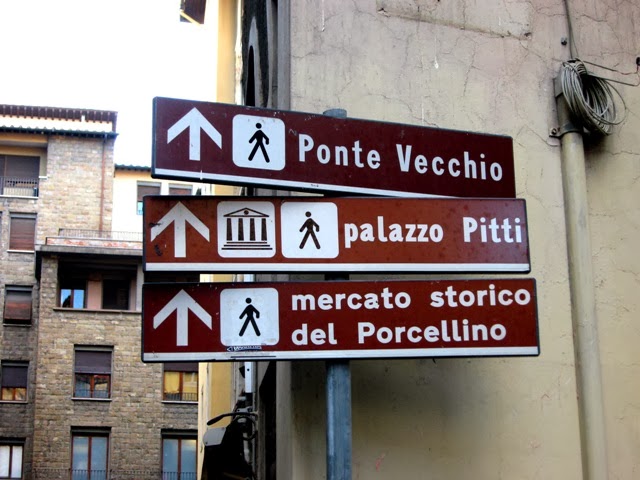
Florence: Ponte Vecchio, romance and history

Hello, my friends! Welcome to My Own Italy to discover Italy with my personal touch!
Our travel today is to Tuscany and we're going to visit one of the most famous bridges in the world: Ponte Vecchio in Florence.
Ponte Vecchio is a very important symbol both from the historical point of view and from the architectural one.

 Built near a crossing of the Roman era, the Ponte Vecchio was until 1218 the only bridge across the Arno River in Florence until 1218. The bridge, as we see it today, was built in 1345 after a violent flood that destroyed the previous one.

 Initially, these were the shops of butchers and fishmongers but by order of Ferdinand I in 1593, they were replaced by goldsmith shops because the smell was felt constantly and the nobles did not enjoy similar scents.


 Above Ponte Vecchio you can see a beautiful part of the Vasari Corridor. This corridor, built in 1565 by Giorgio Vasari, passes just above the shops of goldsmiths that are currently on the sides of the bridge.


 Commissioned by the Medici, it allowed them to move from the Palazzo Vecchio to Palazzo Pitti without having to go through the streets of Florence in total safety.


On Ponte Vecchio in 1901 a bust of Benvenuto Cellini, a famous glodsmith  of the sixteenth century, was inaugurated on the occasion of the fourth centenary of his birth.


During the Second World War, German troops destroyed all the bridges of Florence, except this one. However they blocked the access to the bridge destroying the two medieval buildings on either side. 


 Visitors who come in Florence can't miss an evening stroll on the Ponte Vecchio. At night, in fact, when the wooden doors of the shops are closedand they look just like coffers, the atmosphere on the bridge becomes even more charming and romantic and it really can't be missed!
 

Leisure with me, this is my tourism!
 

lunedì 3 marzo 2014

Montevecchia: enjoy a breathtaking view of Milan and Brianza

Hello, my friends! Welcome again to My Own Italy to discover Italy with my personal Touch!
Ou travel today is to Lombardy and I'd like to suggest you a pleasant trip from Milan to a destination in the Alpine foothills of the rich and aristocratic Brianza: Montevecchia!


Montevecchia is a small town situated in the north of Milan;due to the geographical location (located on a hill about 500 meters above sea level) has a very particular climate more mild in winter and less hot in the summer ... a real treat!


Montevecchia has prehistoric origins: in the surrounding park, at the end of the seventies, were found two camps dating back to Neanderthal and human sapiens, dated respectively the first and the second in 60,000 years to 32,000. These settlements are among the oldest in Lombardy! 

 The word "Montevecchia" is believed to be due to a Roman fortress which was located in place of the actual sanctuary, surrounded by a circle of protective walls of more than 800 meters long. The original name was Mons Vigiliae (Watchtower).
 In the highest point of the hill of Montevecchia there is the Sanctuary of  Beata Vergine del Carmelo  of medieval origins. They think that this church was one of the first built by the Lombards.
     The lombard church on the top of Montevecchia resisted until 1570, when a fire due to "the neglect of the priest" (read by the acts of the visit of St. Charles Borromeo) completely destroyed both the vestments and the church vestments. In 1924 the current sanctuary was dedicated to Our Lady of Mount Carmel.

  In Montevecchia you can also admire Villa Albertoni-Agnesi, home of the world-famous mathematical Gaetana Agnesi .
It was built in '700. The main entrance and the wrought iron balcony above, the staircase, the balustrade carved in garlands intertwined with "putti", are a clear reference to Rococo style. The beautiful Italian garden was perfectly preserved.


Cyclists are enthusiastic visitors of the slope leading to Montevecchia. Once you reach the top you can enjoy a truly breathtaking landscape!! 


Of course, there is nothing better than a meal outdoors enjoying this magnificent view: I suggest you to have a break at Tavern Galeazzino , and taste a typical menu of this place: cold cuts, cheese and good wine!  


Leisure me: this is my tourism! 

martedì 25 febbraio 2014

Lands of Tuscany: Casole d'Elsa

 Hello my friends! Welcome again in My Own Italy to discover Italy with my personal Touch!

Today I'd like to talk you about the always charming Tuscany and about the discover of a nice small village: Casole d'Elsa.
If you are staying at the Hotel Terre di Casole you can reach the village on foot, enjoying a nice walk and a magnificent view!


Casole d'Elsa is a small town in the province of Siena: the village has been disputed since the beginning of 1200 the first between Volterra and Siena, then inevitably involved in the war between the Guelphs and Ghibellines. After a year of Florentine rule, Casole was finally admitted to the domains of Siena after the battle of Montaperti.


The current conformation of this medieval village finds his soul of disputed land, with emphasis on the walls and the Fortress of Casole (Rocca Senese), today the town hall. 


 The city walls of Casole have a shape that reminds a pear, with an extension of the major axis of about 420 meters and a width of about 130. You could came in and went out through two gates that now no longer exist.

Casole still retains the atmosphere of the last outpost and traces of fortifications and palaces emerge everywhere, gradually adapted to the needs of men.
The set of streets, squares in medieval buildings make of Casole one of the most charming villages and best preserved - thanks to recent restoration - of the Val d'Elsa.


Casole is also famous for its Palio: a horse race, ridden by jockeys, which takes place every year on the second Sunday of July at 18.30 in honor of San Isidoro. Its origins are lost in antiquity.


There are six districts participating: they correspond to specific territorial divisions, and each district has its own colors and a badge that identifies it. It 'regulated by a statute, led by a Captain and represented by a President. 


 Leisure me: this is my tourism! 

mercoledì 19 febbraio 2014

Florence and the mysterious Basilica of San Miniato al Monte

Hello, my friends! Welcome to My Own Italy to discover Italy with my personal touch!

Today we continue our travel to Tuscany and I'd like to introduce you to a magic and mysterious place: the Basilica of San Miniato al Monte in Florence.


 The Basilica of San Miniato al Monte stands on a hill to the south-east of the center of Florence, near Piazzale Michelangelo, and is considered one of the finest examples of Florentine Romanesque style.
   

The church is dedicated to Miniato, a Christian of Armenian origin, who was beheaded outside the walls of Florence (in the Porta alla Croce, Piazza Beccaria) for professing his faith.


The legend tells that San Miniato picked up his head and crossed the river Arno and then went up the hill where he was buried and where it is the church dedicated to him.


 The Basilica of San Miniato is full of symbolism: the whole structure seems to have been built on the number 5, which is closely related to the golden ratio, through the pentagon and dodecahedron that comes from this. In the symbolism of the numbers, 5 is the number of the sun but also the quintessential symbol of the spiritual and rooted in the human spirit.

 Inside the Church you may find symbolic animals, some stylized like the pelican: its place is among the various geometric shapes that make up the sacred space in front of the Presbytery, but in an elevated position almost to the roof. The Pelican lends itself to a double symbolic significance, both as an image of Christ, and as the image of God who sacrifices his son by raising him from the dead


The facade of the church is covered in two-tone green and white marble, in the typical Florentine Romanesque style of the eleventh-thirteenth century. On facade stands out of the thirteenth century mosaic depicting Christ enthroned between the Virgin and San Miniato, while on the top of the front is placed a bronze eagle that represents the guild of merchants of the Art of Wool (Art Calimala) that from the thirteenth century had the patronage of the church. 


Outside the Church there is the Bishop's Palace, the former summer residence of the bishops of Florence, who became convent, a hospital and a Jesuit house.


Climb up the stairs of the building and you will be delighted at the sight of one of the world's most famous Italian cities: Florence, here presented in all its beauty!

Leisure with me, this is my tourism!
 

venerdì 14 febbraio 2014

Monastero Bormida, between noble knights and polenta record

 Hello my friends, welcome to My Own Italy to discover Italy with my personal touch!
Our travel today is to Piedmont, in the picturesque village of Monastero Bormida where we expected a fascinating castle and a record delicacy: polenta!


Monastero Bormida, located in the province of Asti, takes its name from to the settlement of a group of Benedictine monks who, around 1050 circa, were called by the Marquis of Monferrato Aleramo from San Benigno Canavese (Abbey Fruttuaria) to plow and sow the lands devastated by the invasions of the Saracens.  


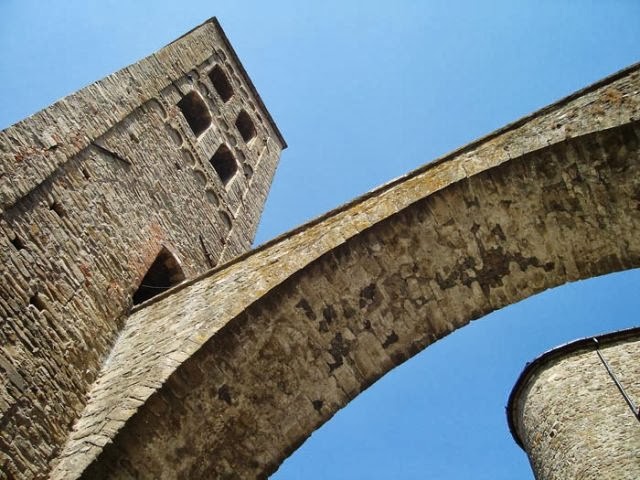
The present castle corresponds exactly to the site of the original monastery, of which there are only a few walls and the bell tower, especially those on the square of the tower.


 Most likely there was a previous monastery founded by the Lombards, as witnessed by the cult of Santa Giulia (whose devotion was widespread in northern Italy by the Lombards) that is still the patron saint of the village and the one to whom is dedicated the eighteenth century parish church, and from some Lombard place-names as Braia, which means the region that is near a river.


During the fifteenth century the first defensive structure was added by the Marquis del Carretto and subsequent renovations and expansions were followed, such as the medieval arch that connects the castle to the tower. The tower, 27 meters high in the Lombard style, presents friezes, and hanging arches made ​​of bricks and stones.


 Today, the castle has a seventeenth-century facade and maintains the sixteenth century loggia on the back which can also be visited. The family Carretto in the middle of the nineteenth century ceded the property to the Della Rovere family which followed the Polleri family of Genoa who sold it to the municipality, the current owner.


In front of the castle is the characteristic lift bridge, and to get inside, you need to go through the old entrance door in the ancient city wall.
   The tour begins along the outer perimeter of the castle in order to understand the location and history of the structure over the centuries. Then you enters inside in the plans nobles, whose rooms, transformed in the seventeenth century, have mosaic floors and frescoed ceilings sailing and cruising in floral and geometric patterns.


The halls will host the farm museum, opening soon. The visit continues with the walkways on the top and ends in the spacious cellars.
  The medieval Monastero Bormida square, in front of the castle every year, the second Sunday of March, is the theater of Polentone Festival, one of the oldest gastronomic events in the history of Italian cuisine, which takes place from 1573.


 It is from the sixteenth century that this area celebrates at the end of winter, its most traditional product, that is corn flour, which also took the path of organic and integral.
The event was created by ancient propitiatory ceremonies concerning the arrival in the country of magnin which stagnated the pots, and according to a legend it is linked to an act of generosity of the Marquis Del Carretto, who fed with polenta, sausage and onion omelette a group of boilermakers exhausted by hunger, who donated to the land the huge copper pot in which it is still cooked the huge polenta, which is served to the public with the accompaniment of sausage and onion omelette.


On this occasion in the alleys of the old town are recreated with philological care the ancient crafts, performed by the elders of Monastero and the neighboring countries, with vintage gear. It will be possible, in addition to polenta, taste and buy other agricultural produce, wine and dairy hills of Asti.


 The following Monday, classical Polentino of polenta and wild boar.
In short, if you are a gourmand and loved the culinary tradition of our beautiful country, and you are eager for a bit of fun, leisure me: this is my tourism!


giovedì 6 febbraio 2014

Camogli: the pearl of the Ligurian Riviera

 Hello, my friends! Welcome to My Own Italy to discover Italy  with my personal touch!
Our travel today is to Liguria.
Let's go for a walk that I do consider one of the best I've ever made: we start from Recco to get to Camogli, the pearl of the Ligurian Riviera. 


Once you are in Recco, in the province of  Genoa, I suggest you to park your car and star your walk along the sea.
 The beach here is of tiny colored stones: they all gives the inlet a very special light.


You can't miss a break to eat the famous cheese focaccia warm and freshly baked!


Now, you can continue walking along the beautiful promenade that runs alongside the road, leading directly to the bay of Camogli.
The center of Camogli occupies the valley to the west of Portofino.


 Camogli is built along the slopes of a relief almost to the sea.
 This aspect has the orographic effect of ensuring a temperate climate, typical of some parts of the east of Genoa, failing the cold winds coming from the Po Valley to the coast.
 Also for this Camogli is so appreciated by tourists!


 Many beautiful trails depart from Camogli for excursions. In an hour's walk, passing through the village of San Rocco di Camogli, you can reach the summit of Mount Portofino to enjoy the beautiful view of the Gulf of Genoa.
 Also from San Rocco, you can go to Porto Pidocchio, charming little harbor at Punta Chiappa, popular destination for tourists throughout the year.

Leisure me: this is my tourism!